ScalePad Quoter: turn won quotes into projects and charges
Won quotes land in a pending queue; the wizard turns each into a real project with phases, tasks, and charges. Pairs with Autotask, ConnectWise shops use ConnectWise CPQ.
On this page · 8 sections
The handoff from sales to delivery is where MSPs leak money. A quote is won, and then somebody has to notice, build the project, remember the hardware, remember the recurring services, remember to bill the one-time items, and remember to move the opportunity in the PSA. Current's Win Quote Engine takes that whole chain and makes it a queue and a wizard: won quotes appear in front of a project manager automatically, and a few guided steps later there is a real project, real charges in Autotask, and an opportunity that has moved itself.
Currency
A quote carries the currency it was priced in. Current never converts money. When a quote's currency is different from your workspace currency, the won-quote queue and the conversion wizard flag it and the figures stay exactly as the quote states them, so what reaches Autotask is the number you saw. Your workspace currency is set in Settings › General › Region and words.
Connect Quoter (Tenant Admin)
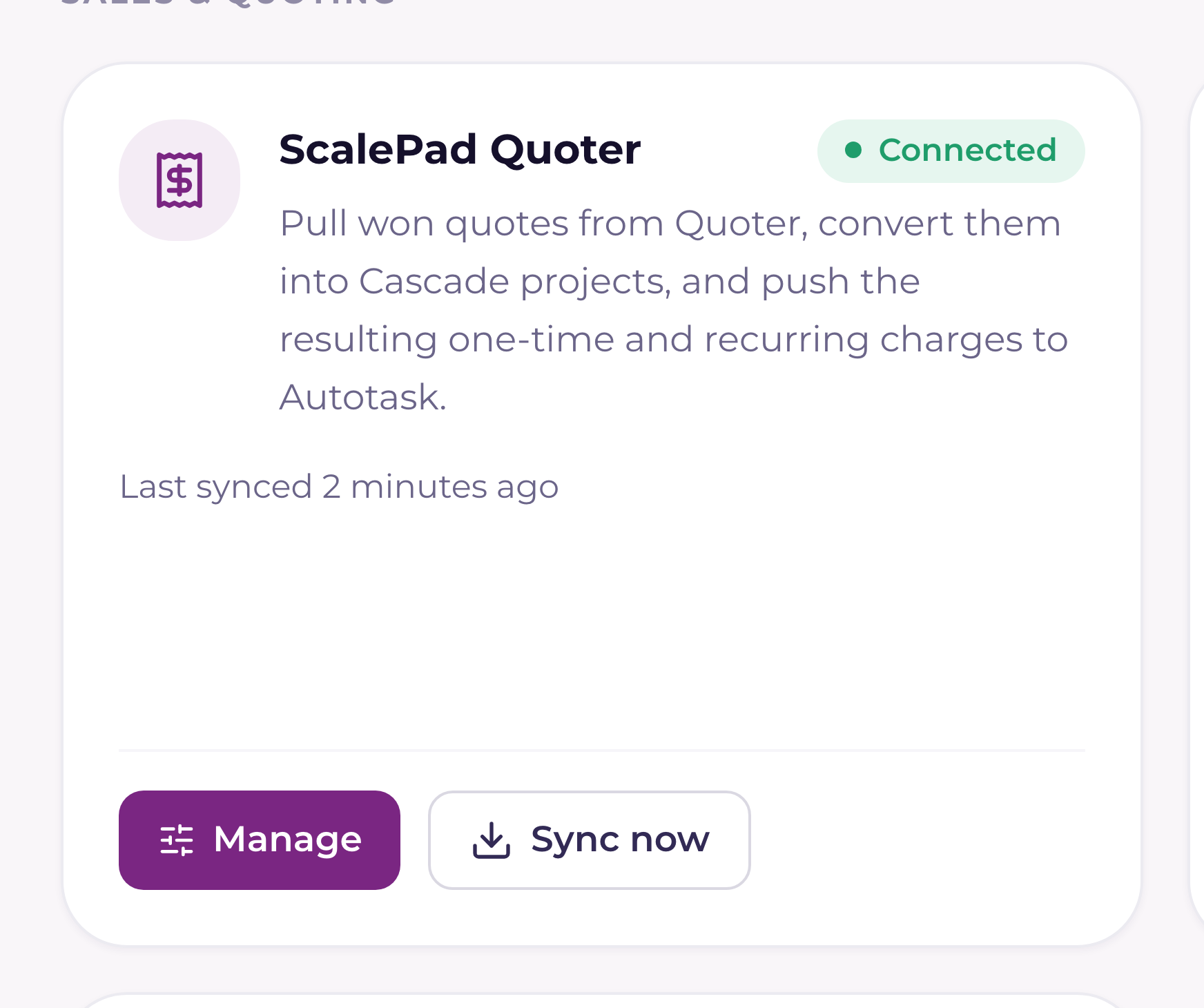
Settings › Integrations → ScalePad Quoter → Manage. It sits in Settings › Integrations, so it's tenant admins and super admins only. The drawer walks four numbered sections (Connection, Webhook, Won-quote workflow, What syncs), and you need Autotask connected first, because the stage picker reads your live Autotask opportunity stages.
- 11 · Connection, paste your API credentialsCurrent accepts either kind of Quoter key. Pick the one you have under Which key do you have. A ScalePad API key is made in the ScalePad hub under API › New API key: copy the secret key it shows once and paste the key itself, not its name. A Quoter Client ID and Client secret are made in Quoter under Account › API Keys by the Quoter account owner. Then pick a Hash key (any long random value; you'll set the same value on the webhook in step 2) and press Test & save connection. Current checks the key against Quoter before anything is stored, then keeps it server-side only. The browser never holds it.
- 22 · Webhook, paste Current's URL into QuoterOnce Test & save succeeds, the drawer shows your webhook URL (it doesn't exist before the connection is saved). Copy it into Quoter → Settings → Integrations → Webhooks, paste the URL, choose the JSON format, and set the same Hash Key you entered in Current. A win then reaches Current within seconds, and every delivery is signed and checked. Current never shows a stored hash key back, only whether one is set.
- 33 · Won-quote workflow, map two Autotask stagesPick the Ready stage (where Quoter parks a won quote's Opportunity. This is what fills the queue), and the Converted stage (where Current moves it after conversion, which clears it from the queue). They cannot be the same stage, or the queue would always be empty. Set how far back to look for won quotes on the first connect, 30 days by default.
- 44 · What syncsWon quotes come in; project charges flow both ways; the opportunity stage write-back goes out. Nothing else in Quoter is touched.
The queue: "Won quotes, ready to convert"
The queue lives on My Day as a card, with a banner across the app so nobody misses it. It is visible to project managers and admins only, account executives see their own won opportunities elsewhere, and engineers and partners never see it at all.
It has two sections. Matched in Autotask is the confident set: Current found the Opportunity sitting at your Ready stage. Needs a look is the unconfirmed set: Current has the quote from Quoter but can't confirm it against Autotask yet. Clicking any row opens a detail drawer with the full story, the money as Autotask reports it, and a Refresh from Autotask & Quoter button.
Running the Win Quote wizard
Converting is a project-management action: project managers, tenant admins, and super admins only. Click Convert on a row and the wizard opens. Nothing is written until the final confirm, and on the project path, an Autotask-synced conversion dry-runs the Autotask side of the plan before that confirm, so what you approve is what happens.
- 1QuotesConfirm the quote, and combine others if the same partner won several quotes that belong to one piece of work. Re-entering a quote that has already been converted requires an explicit typed confirmation, so you can't accidentally build the same project twice. If the AE typed an internal note on the quote in Quoter (a ship-to address, a special instruction) it appears here in a bold amber “Internal note from Quoter” banner at the top of the screen (the quote-level note plus each line item's note, combined), and you have to tick “I've read this” before you can move on. No note means no banner and no extra step. Under the quotes, pick where the work lands: Project, for scoped work with phases, tasks, and scheduling, or Post-sale ticket, for hardware-and-labor fulfillment (order it, install it, bill it) as a single Autotask ticket.
- 2Project, partner, name, PM, mode, deadlinePick or create the partner company, name the project, assign a project manager, and choose the mode: Autotask-synced (Autotask stays the source of truth for time and billing), or Current-native. Charges require Autotask-synced. They push to the Autotask project. This is also where the Target go-live / hard deadline lives now, a prominent date field. Give it a date and the whole plan schedules backward so the last task lands on it. If that date physically can't fit. The plan would have to start in the past to make it. Current shows a bold red warning right here, so you catch it before you build instead of after. See "Project modes: PSA-synced or Current-native".
- 3Plan: the three questions, then how the plan gets writtenOne screen. First the three questions that change the plan. Ordering hardware or software? adds a high-priority day-1 “Order hardware & software” task. Holding a kickoff? lets you pick internal, a kickoff call with the partner, or both, and adds the task or tasks you picked. Contract or agreement change? decides what the “Contract/Agreement Update” task is: Yes, or a quote with recurring lines, makes it a critical contract change; No on a one-time-only quote makes it a high-priority billing review. The task is always added, with the signed quote filed on it, and goes to your billing owner (see the Billing step below). All three must be answered before you can continue. (The hard-deadline question used to live here. It now sits on the Project step above, as its own Target go-live field.) Then, below the questions, how the plan gets written: read the quote PDF (Current pulls the Opportunity's PDF from Autotask and drafts phases and tasks from it), paste a scope of work and let AI draft from that, start from one of your playbooks or Autotask templates, or create a bare project with just the day-1 tasks and build the rest yourself. While AI drafts (about 15 seconds, 20 for a PDF), the step shows your project building itself: the phases appear, every task bar grows across its real dates, the links between tasks draw in, and the phase, task and hour counts climb. When the board is done, the review table opens on its own. This part of the step also carries a Professional-services hours sold panel. Current counts the labor hours off the quote automatically, and you can edit the figure. When AI drafts the plan it's told that sold-hours number and your working-day window, so what it writes is built to fit the hours you sold and the deadline you set. Every generated plan is fully editable before you commit. See "Project templates and PMI playbooks" and "Matching the plan to the hours you sold" below.
- 4Billing: everything that goes to your PSA, on one screenA summary at the top says exactly what will be written: the charges and their total, any recurring lines (they go on the contract task, never as charges), any one-time lines you left unticked, how the labor bills, and who owns the billing. Below it, three sections. Charges: the line items, loaded live from Autotask. Tick the products and materials that should bill (see below). Labor lines are never charges. Each line also carries a Counts as sold hours checkbox (labor lines are ticked by default), so you decide exactly which lines feed the sold-hours total on the Plan step. Labor billing (only when a labor line is ticked): Fixed fee (a fixed price contract billed in parts the billing owner marks ready), Time and materials (the hours your team logs), or Already covered (an agreement that already includes the work), then the new or existing contract, the parts or the agreement. See "Labor billing on won quotes: fixed fee, time and materials, or already covered". Billing owner: shows whether this is a Contract change (a recurring line is ticked, or you answered Yes to the contract question) or a Billing review (one-time charges only), and asks for a billing owner. The owner is filled in from your workspace's saved billing owner, else your only Finance user; with neither, you pick one before you can continue. The “Contract/Agreement Update” task is assigned to that person in Current and in Autotask. See "Billing owner on won quotes".
- 5Review → Create project & syncThe whole plan on one page: project, tasks, charges, the stage move, whether the partner gets portal access, and whether they're emailed when work actually starts (both on by default). A quoted-vs-planned hours banner sits here too. If the plan's task hours don't match what you sold, Scale to match lines them up in one click (see below). This button is the first and only write. It runs step by step, is safe to retry, and if any single step fails it tells you exactly which one.
Matching the plan to the hours you sold
A project that quotes 40 hours and then plans 12 loses money quietly. The wizard keeps the two in view. On the Plan step, a Professional-services hours sold panel counts the labor hours straight off the quote's lines and lets you correct the number; on the Billing step, a Counts as sold hours checkbox on each line (labor ticked by default) decides which lines feed that total. Current hands both the sold-hours figure and your working-day window to the AI, so the draft it writes is built to fit the hours you sold and the deadline you set.
As you review the draft (and again on the final Review step) a banner compares the plan's task hours to the sold hours. If they've drifted apart, Scale to match nudges every task up or down in quarter-hour steps until the totals line up, never taking a task below 0.25 hours and never touching a milestone. It's one click, it's yours to undo before you commit, and the project manager always has the final say. Current sizes the plan for you but never overrides your judgement.
Charges: one-time bills, recurring becomes a task
One-time product and material lines you tick are pushed to Autotask as project charges (or ticket charges, on the post-sale ticket path). That's the money you're owed for the work, landing where your billing runs. Labor lines are never pushed as charges: they bill the way you chose in the Billing step's Labor billing section (fixed fee, time and materials, or already covered). See "Labor billing on won quotes: fixed fee, time and materials, or already covered".
On the project path, recurring items are deliberately NOT pushed. Recurring revenue belongs in a contract, and no automation should guess at your contract structure. Instead Current adds one critical day-1 task, “Contract/Agreement Update”, with one checklist item per recurring line from the quote, assigned to the billing owner you picked on the Billing step, and a task with unchecked checklist items cannot be marked complete. A quote with one-time lines only still gets the task, as a high-priority (not critical) billing review, so the billing person checks the one-time charges too.
The signed quote PDF is filed on that task too. Open the task in Current and its Signed quote section shows the PDF, the same one the quote drawer shows. On an Autotask-synced project the PDF is also attached to the task in Autotask, named the same way as the copy filed to the company, so whoever builds the contract has it in front of them. If that filing misses (the project wasn't built in Autotask yet, say), the section says why and offers File to Autotask to a project manager. Before September 2026 this was two tasks, “Contract / agreement change” and “Set up recurring billing & contract”; projects converted back then keep both.
The post-sale ticket path is different: a ticket is one-time by definition, so service and subscription lines are not treated as recurring there. They're shown to you unchecked, and they only bill (as one-time ticket charges) if you deliberately tick them. Its Billing step asks the contract question there (the ticket path has no Plan step) and the billing owner, and the billing work becomes an internal ticket in Autotask assigned to that person, in the queue, status and priority your admin set once in Settings. Until an admin turns billing tickets on, it stays in Current and the owner sees it on My Day.
If a quote offered the customer a choice, optional “choose one” line items. Current leaves those lines UNCHECKED on the Billing step and badges each one “Optional,” with a banner reminding you to tick only what the customer actually accepted (open the signed quote if you're unsure). This is deliberate: an accepted multi-option quote keeps every option on the Autotask quote, so pre-ticking them all would bill for hardware the customer never bought. The accepted-total check at the top of the step turns green once your ticked lines match what the customer signed for.
The post-sale ticket path
Not every won quote deserves a project. A firewall replacement or a batch of laptops is a fulfillment job, and the wizard has a shorter route for it: Quotes (where you pick the post-sale ticket) → Ticket → Billing → Review, ending in Create post-sale ticket. The Ticket step requires a ticket title, an Autotask queue, an owner, and a due date (Autotask requires one), plus optional priority, starting status, work type, contract, and a procurement owner, the person who actually places the order. The Owner list follows the queue: Autotask only lets a ticket be owned by someone assigned to its queue, so the wizard lists the people assigned to the queue you picked. If the person you want isn't listed, add them to that queue in Autotask (Admin → Resources (Users) → the person → Service Desk Queues), and reopen the wizard. Should an owner outside the queue get through anyway, the ticket is still created, without an owner, and the result screen tells you how to add them to the queue and assign it. The queue and work type pre-select from your saved defaults in Integrations → Won quotes; with nothing saved, Current looks for a queue named like "Post Sale" and a work type named like "Fixed Fee", so tickets stop landing in your remote-support queue under the zone's default work type. It converts exactly one quote. Current creates one Autotask ticket with a fixed order-first checklist (Place hardware order, Order received, Schedule service), and pushes the ticked lines as ticket charges. The ticket is also linked to the Autotask Opportunity the quote came from, automatically: the Opportunity field is set on the ticket at creation, and the Post-sale page shows the same link on each ticket. If a zone refuses the link, the ticket is still created and the result screen tells you to set the Opportunity by hand.
Charges are pushed the moment the ticket is created (before the quote is marked converted), so a slow Autotask response can never leave a converted quote with an empty ticket. Autotask requires a product or billing code behind every ticket charge, and each line carries the one you saw on the Billing step: product-backed lines keep their Autotask product, and service lines use the billing code the wizard picked (your first synced code, unless you changed it). If a charge does fail to push (a transient Autotask hiccup, or the ticket ran out of time mid-import), the Post-sale page shows how many failed on that ticket and gives you a “Retry charges” button that re-pushes only the ones that didn't land, and repairs older stuck lines by re-reading the quote's own line items. It's safe to tap as many times as you like. An already-synced charge is never sent to Autotask twice.
What happens after you convert
- Current moves the Autotask Opportunity to your Converted stage (on both the project path and the post-sale ticket path), so a converted win doesn't linger at your Ready stage in Autotask's own "won but not processed" view. Recording the conversion is what clears the quote from Current's queue; if the stage write-back fails, Current tells you so on the result screen and you move the Opportunity in Autotask yourself (retrying the conversion re-attempts the move).
- The signed quote PDF is filed onto the company in your PSA. Current copies the PDF from the won opportunity to the company's own attachments, renamed to the company name, the quote/offering name, and the date you converted (for example "Acme Corp Managed Services 8-1-27.pdf"), so it shows up in the company's Files area right away. This is best-effort: if the PDF can't be filed (it's a link rather than an uploaded file, or the PSA rejects the upload), the conversion still completes and Current shows you a heads-up so you can file it by hand. It's live for Autotask and ConnectWise; HaloPSA filing follows once its attachment API is verified against a live system.
- If you left partner-portal access ticked, the partner is granted access to their project. If that grant fails for any reason, the conversion still stands and Current tells you to grant access from the project's Partner Access panel. See "Invite a partner to the client portal".
- If you left partner notification ticked, the partner is emailed when the project actually starts, not when it's created. "Started" means real movement: the first task leaves a not-started status, the first time entry lands, or the earliest task's start date arrives.
- The account executive who sold the opportunity is notified when their project starts and again when it finishes. Nobody has to chase delivery for a status update.
For the other ways a project gets born, see "Create a project: from scratch, a playbook, or a won quote" and "Building projects in your PSA from a template or won quote". For the complete list of everything Current ever writes into your PSA, see "What Current writes back to Autotask (and when)".