
Connect N-able Cove backup to Current
Cove brings server, workstation and Microsoft 365 backup evidence into Current. Device backup accounts and Microsoft 365 organizations stay separate, so an organization is never counted as a protected machine.
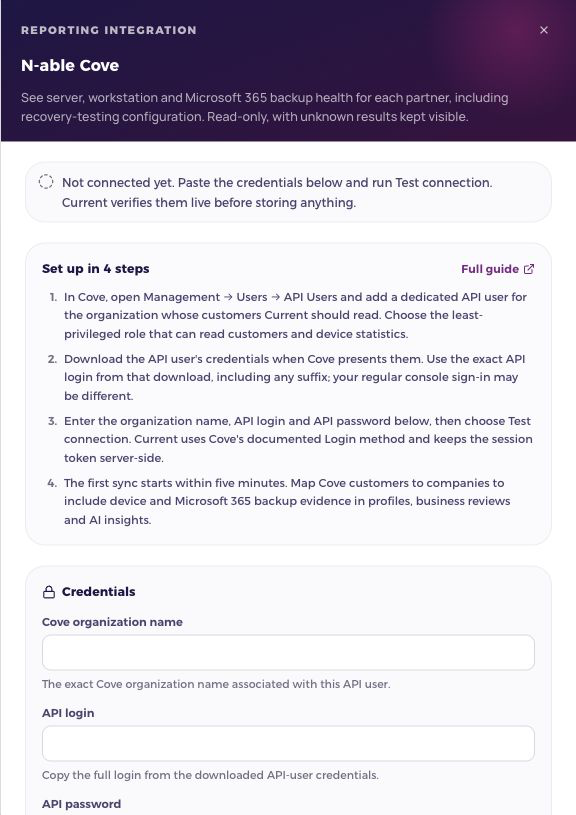
Before you connect
- 1Create an API user in CoveOpen Management → Users → API Users. Add a dedicated user for the organization whose customers Current should read. Choose the least-privileged role that can enumerate customers and device statistics.
- 2Keep the downloaded credentialsCove provides the API-user credentials at creation. Copy the exact API login, including its suffix. Current uses the documented Login method with the organization name, API login and API password.
- 3Test and save in CurrentOpen Integrations → Backup & continuity → N-able Cove → Manage, enter those three values and choose Test connection. Session visas are held server-side and refreshed as Cove responds.
Reading backup health
A documented failed, aborted, interrupted, completed-with-errors, faulted-in-progress or over-quota state needs attention. A successful backup older than 48 hours also needs attention. Active Microsoft 365 workload failures can flag the organization even if its aggregate status is missing. Unrecognized or missing results stay unknown. A current run is not treated as a completed success.
| Signal | What Current can say |
|---|---|
| Device backups | Backup accounts, last successful backup, reported status and whether attention is needed. |
| Microsoft 365 | Organizations and available Exchange, OneDrive, SharePoint and Teams workload states. |
| Mailboxes | Exchange user and shared mailbox counts from the latest backup session. These are not total licensed seats and are not combined with other providers’ seat totals. |
| Recovery | Whether recovery testing or standby imaging is configured. The documented configuration field does not prove that a recovery test succeeded; successful boot verification stays unknown. |
Connect, map, then review
A workspace admin connects the feed in Integrations. After a successful test, the first sync is queued and starts within five minutes. Current reads in bounded passes and resumes from the last saved page, so a large estate may take several passes. A completed sync schedules the next refresh six hours later. Sync now queues work; it does not mean the data is already refreshed.
Open Manage and map each vendor customer to a Current company. Current matches exact, unique names automatically; ambiguous names stay unlinked. Review the matches. A manual mapping, unlink or Ignore choice is preserved across syncs. Saving a mapping immediately updates the company’s imported records.
Where the information appears
- +Company records show the mapped posture and an expandable list of devices or backup accounts. Account executives see only their authorized companies; external partner viewers cannot read the underlying integration mirrors.
- +Business reviews and AI company insights use the same company-scoped evidence. These are current snapshots, even when the review covers an earlier period.
- +Dashboards and reports use the shared metric catalog. Missing health is not a successful result; incomplete or stale data stays visible.
If a sync needs attention
| What you see | What to do |
|---|---|
| Credentials rejected | Check the dedicated API user and replace expired credentials in Manage. Never send tokens or passwords in a support message. |
| API access unavailable | Check the API user’s reporting permissions and, for N-central, the server version. Inventory can remain available while another endpoint is unavailable. |
| Waiting or retrying | Current saves progress and retries automatically. A vendor rate limit keeps its retry deadline even if Sync now is clicked again. |
| Sync error | Read the explanation in Manage. Earlier observations remain available with their dates. Persistent sync faults also reach Current’s super-admin Errors console through the existing error pipeline. |
| No company data | Check that the vendor customer is mapped to the intended company and that the first sync has completed. Unmapped records do not appear on a company profile. |
Rotate credentials or switch accounts
Replacing credentials for the same server or organization keeps company mappings. To switch to another server or Cove organization, disconnect first. Reconnecting to a different account resets this integration’s imported cache and mappings so reused vendor IDs cannot attach another organization’s data to an old company. Disconnecting stops future syncs and keeps existing observations until an account change replaces them.