
The same company twice: find the duplicates and merge them
One company entered twice is the quiet kind of mess. The deals sit on one record, the notes on the other, and the account no longer adds up. Possible duplicates (under Sales in the menu) finds those pairs for you, shows the evidence behind each one, and merges them so nothing is lost.
What counts as a possible duplicate
Current looks for three things. The same name once punctuation and capitals are ignored, so "Acme, Inc." and "ACME Inc" are one match. The same name once the company suffix comes off, so "Acme" and "Acme LLC" are another. And the same website under two different names, which is how a record created from a web lead often ends up beside the one your PSA already had.
Consumer mailbox domains are ignored on purpose. If somebody typed a prospect's gmail address into the website field, that is not evidence two companies are the same, and without this rule gmail.com would be the largest duplicate group in every workspace.
Which record survives
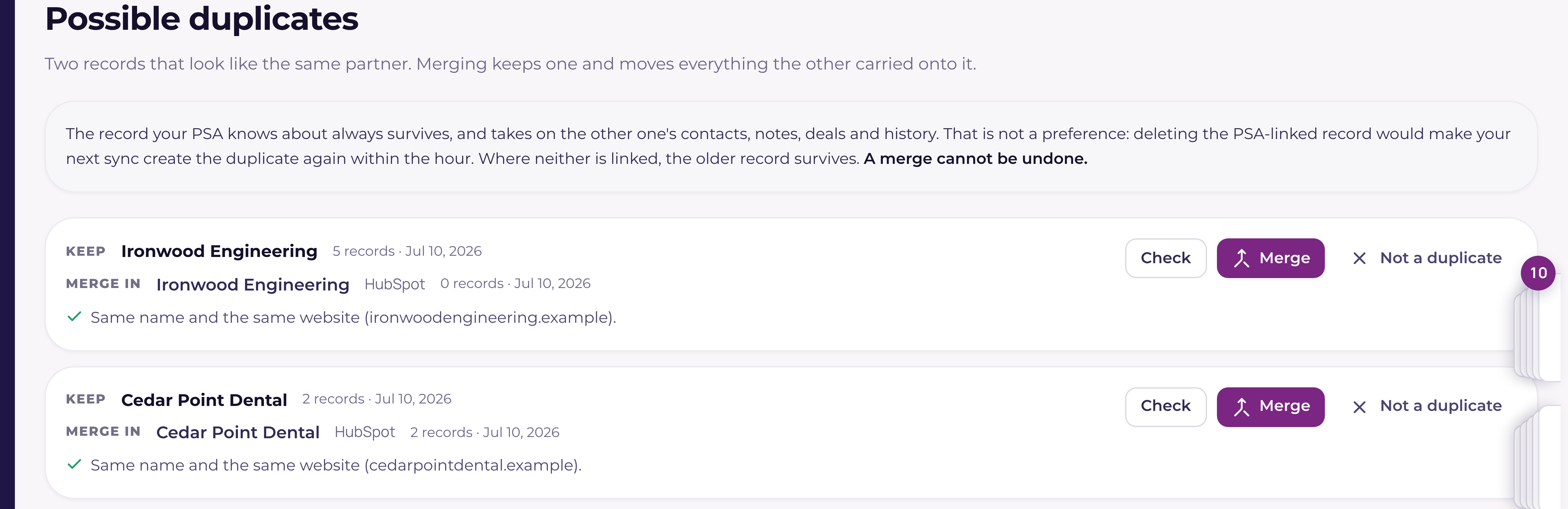
The record your PSA knows about always survives, and takes on everything the other one carried: contacts, notes, deals, quotes, activities, tickets, documents, the lot. That is not a preference. Deleting the record your PSA is linked to would only make your next sync create the duplicate again within the hour. Where neither record is linked to your PSA, the older one survives.
| What you see | What it means |
|---|---|
| Same name and the same website | Two signals agree. Current is confident these are one company. |
| Same name, and only one is in your PSA | Almost always a record somebody typed in beside the one that syncs. |
| The same name apart from the company suffix | "Acme" beside "Acme LLC". Usually one company, sometimes a real corporate split, so this one waits for you. |
| Different names on the same website | Worth a look. It can also be two parts of a group you bill separately, so check before you merge. |
| Both are linked to different records in your PSA | Current will not merge these. They are two live records in your PSA and the merge belongs there first. |
The three groups
Above the list, three buttons split everything into Safe to merge, Needs a decision, and Merge in your PSA, each with how many pairs are in it across the whole workspace. Safe to merge is the group where two things agree, and the button at the top right clears a page of them at once. Needs a decision is usually the biggest group and the one the suggestions are for. Merge in your PSA holds the pairs Current will not touch, because both records are live in your PSA and the merge belongs there first.
The counts are pairs, not companies. Three records of the same company are three pairs, and merging two of them leaves one pair behind.
Let Current narrow it down
Most of what this page finds is not clear cut, and a long list of maybes is no easier to work through than the duplicates themselves. Suggest, at the top of the page, reads the pairs in Needs a decision and tells you which look like one company, which look like two, and which are genuinely unclear, with one sentence naming the evidence it used. It works through a batch at a time and never asks about the same pair twice, so press it again and it moves on to the next set.
It reads the name, the website, the town, the industry, whether your PSA has a matching record, how much history each record carries, and the email domains the contacts use. It is never given revenue, contracts or ticket history, and never anybody's email address, only the domain.
Merging a pair
Check runs a dry run. It changes nothing and tells you how many rows across how many tables would move onto the record you are keeping, so you can see the size of what you are about to do. Merge then does it. Large accounts take a moment, because every deal, contact, note and activity has to be repointed one at a time.
Not a duplicate sets the pair aside for good. Use it on two companies that genuinely share a name or a website, and you will not be asked about them again.
Stopping new ones
New company now refuses a company you already have. If the name or the website matches an existing record you get "that company already exists" with an Open it button that takes you straight to it, rather than a second copy under a slightly different spelling. A CSV import does the same thing quietly: a row that matches a company you already have is linked to it instead of creating another, and the import carries on.
Who can do this
Merging is for tenant admins and sales leadership only. A merge deletes a company and rewrites timelines that mostly belong to other people, so an account executive, including one with Full CRM, can see a duplicate on a company record but cannot merge it.
Why the list is one page at a time
Possible duplicates shows the strongest matches first and only a page of them. Clear that page and the next set appears. The search gets more expensive as merges concentrate history onto the survivors, and a page that took too long would come back looking like you had no duplicates at all, which is the one wrong answer nobody questions.